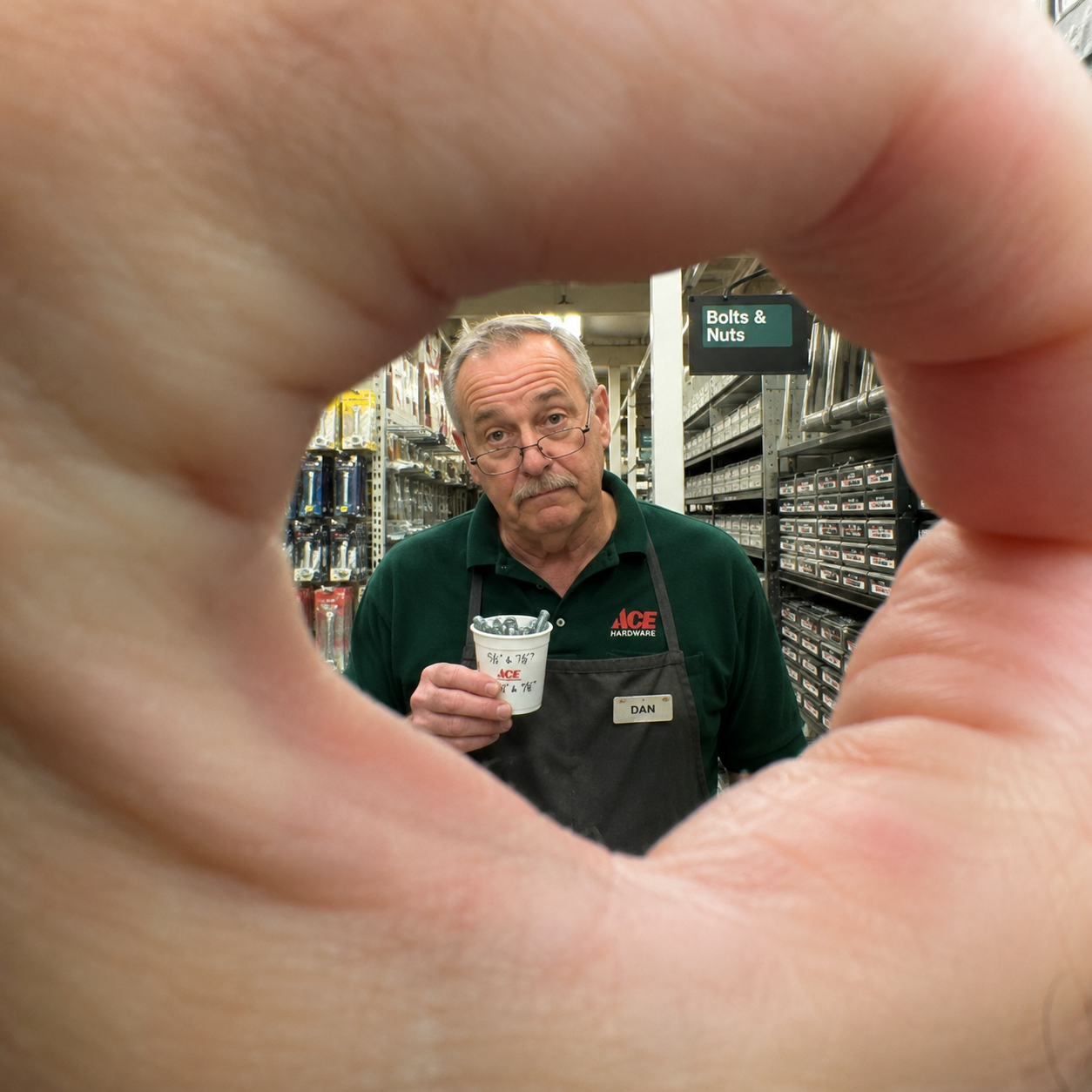
The Doughnut Hole Standard
There is a particular kind of confidence that builds in a man watching a home improvement show from the safety of his own couch. Someone on screen is re-hanging a gate, or shimming a doorframe, or replacing a length of something structural, and I will find myself nodding along, mentally cataloguing the exact spot in my own house or yard where this same fix is, at this very moment, waiting for me. A hinge. A bracket. Something has been loose for months and I have simply been waiting, it turns out, for television to give me permission to notice it.
This confidence survives the walk to the car. It survives most of the drive. It survives, even, the automatic doors and the first thirty feet of the aisle, that stretch where you’re still riding the momentum of having had a plan. It does not survive contact with a salesperson holding a small paper cup of loose bolts, looking at me with the patient expression of a man who has seen this exact confidence arrive and depart a thousand times before.
“Do you need the five-eighths or the seven-eighths?”
This is not a trick question. It is, in fact, the only question. It is the one piece of information the entire errand hinged upon, and I am standing in front of it having somehow never once considered it. I had a bracket in my head. I did not have a bracket in my pocket. The show never mentions this part. Noone on television has ever paused mid-project to hold a bolt up to the camera and say, now, this is important. They just cut to the finished gate, swinging serenely, as if the correct hardware had assembled itself out of pure intention.
I have handled this moment two different ways over the years, and I am not proud of either.
The first is to simply guess. Say “five-eighths” with the flat, unbothered tone of a man who has never doubted anything in his life, take the bag, thank him, and then, once he has turned to help the next person and is no longer watching, quietly double back, grab a few of the seven-eighths, and leave through a different register like a man evading a debt.
The second, and I think the more honest of the two, is to hold up my hand, curl my index finger into a rough circle against my thumb, and say, “About this big?” As if I am not a grown adult in a hardware store but a child being asked how big the fish was. The salesperson looks at the doughnut hole I have made of my own hand. I look at it too, as though it might clarify itself. It does not. It is just a hand, shaped like nothing in particular, representing a bolt that exists in perfect clarity somewhere in my house and nowhere at all in this aisle.
What strikes me, standing there, is how completely the confidence evaporates and how quickly it’s replaced by something almost peaceful. There is no version of this transaction where I come out ahead. The doughnut hole is not going to become more specific no matter how long I hold it up. So I have made my peace with the finger circle. It costs me nothing but a small, temporary dignity, and dignity, I have found, regenerates fully by the time I’m back in the car.
I bring home the bag. I am almost always wrong about something: the length, the gauge, the finish, some property of the bolt I did not know bolts had properties of. So I go back. The salesperson, if it’s the same one, does not remark on this. He has clearly seen the whole arc before: the confidence, the doughnut hole, the return trip. There are probably men all over town standing in garages at this very moment holding the wrong bolt and wondering whether anyone at the store will remember them.
They will.
It doesn’t matter. Dignity regenerates somewhere around the second traffic light.
I have come to accept that there are quite a few things in life I approach with enormous conviction right up until someone asks me for a specific number. Then I make a little circle with my fingers and hope it’s close enough.
It never is. I go anyway.