Catch and Release
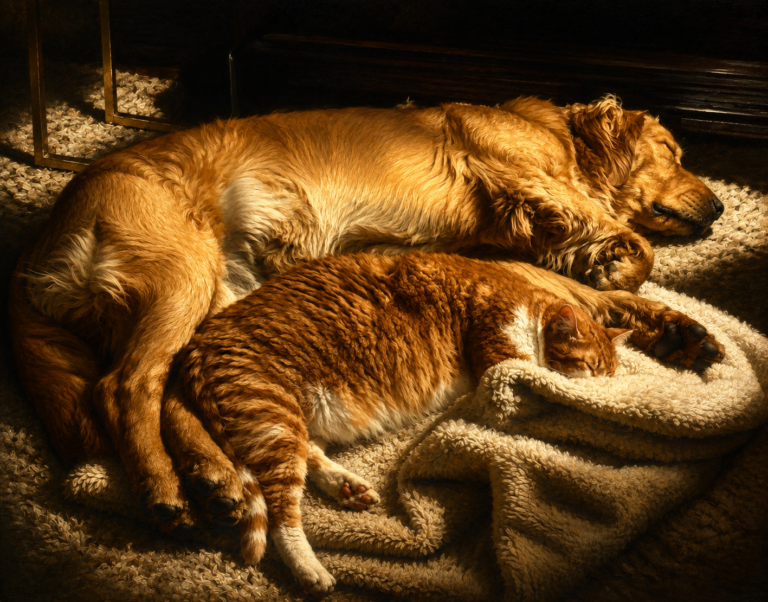
Winston keeps himself impeccably groomed. He bathes with the seriousness of a man preparing for a portrait, and when he is not bathing he is being bathed, against his will, by the Boyz, who treat him less like a cat and more like a job. He tolerates this the way royalty tolerates a parade. He has never once asked for it and he has never once stopped it.
What Winston has not groomed out of himself is the hunting. He is good at it. He is, in fact, better at it than anyone in this house would prefer, and he operates under a private legal theory that the catch is his and the disposition of the catch is therefore also his, to do with as he sees fit. What he sees fit to do, almost always, is play.
Last night he brought home a finch.
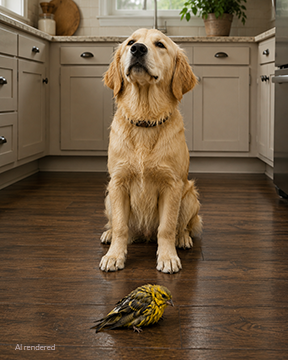
I want to be precise about the condition of the finch, because the condition of the finch is the whole story. It was alive. It was in his mouth. It was fluttering, which is a word that does a great deal of work when the thing fluttering is small, yellow, and being transported through a cat door into a kitchen.
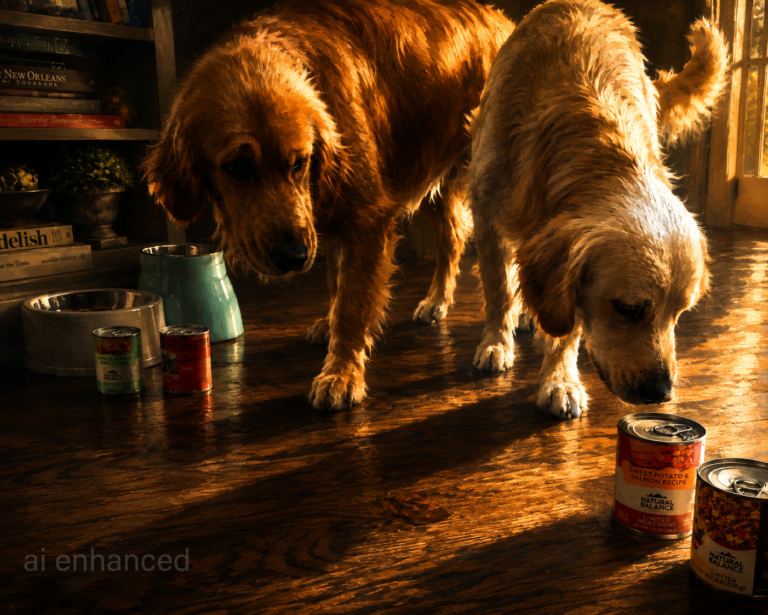
Captain saw it first. He has a particular look he gives when something has entered his understanding of the house that should not be there, a kind of slow blink followed by a recount, as if he is asking the room to confirm what he just witnessed before he commits to a reaction. He did this three times. Then he left. Not casually. He went up the stairs at a pace I associate with bad news, and a few seconds later I heard the sound of bad news being received, which is Morgan coming down those same stairs at considerably less than a controlled rate of speed. There was a fall in there somewhere. There may have been two.
Morgan’s arrival, dramatic as it was, had the immediate effect of frightening Winston into letting go of his houseguest, who promptly remembered that he could fly and did so, directly into the open architecture of our living room.
What followed I can only describe as parkour, performed badly, by animals with no business attempting it. The Boyz do not walk on their hind legs under any normal circumstance, and yet for the better part of three minutes they were airborne more than they were grounded, launching off the ottoman, missing, recalibrating off a dining chair, missing again, accumulating a small inventory of bruises and dignity loss across the living room, the kitchen, the study, and back. Winston, for his part, abandoned the ground game entirely and took the high route, working the curtain rod, the top of the bookcase, the cabinets, watching the chaos below him with what I choose to interpret as satisfaction.
My wife was not present for any of this. I want that on the record, because what happened next would not have happened if she had been five minutes earlier or five minutes later, and the fact that she was neither is the kind of timing you cannot write into a piece, only report on after the fact.
Winston made his move off the curtain rod, a clean swipe that put the finch, exhausted now, down on the kitchen counter. This gave Captain, who had been one step behind the whole engagement, the opening he needed. He rose up on the counter’s edge and took the bird gently in his mouth. Gently is the operative word. He did not catch it the way Winston catches things. He held it the way he holds everything he loves, which is to say carefully, and with great pride in the holding.
It was at that exact moment that my wife came through the garage door.
Captain forgot the bird entirely. What he remembered was that his favorite person had just walked in, and so he did what he always does for her, he trotted over and sat, presenting himself for the greeting he is owed every single time regardless of circumstance. She said hello. He sat there, pleased, and then placed a damp, exhausted yellow finch at her feet as if it were the second half of the greeting.
I scooped the bird up fast, hoping she hadn’t seen it. She had. Hoping she hadn’t seen me do the scooping. She had seen that too. I carried it to the patio door with as much ceremony as the moment could bear and let it go, and it took off into the evening with, I have to assume, one hell of a story to tell whatever was waiting for it in the trees.
When I came back in, she was still standing in the kitchen, and her face was doing two things at once, curious and angry, unable to settle on just one. She has known since the day we brought the Boyz home that surprise was no longer a feature of this household, and I watched her run that math in real time anyway, checking it against what she had just watched happen on her own counter. I asked what she wanted for dinner.
“Not bird,” she said.